Adaptive Flow Delivery Is Here: Turning AI's Speed Into Delivery That Compounds
The book is available now on Amazon. AI made building almost free — here's how Adaptive Flow Delivery turns that speed into delivery that compounds instead of evaporates.
Adaptive Flow Delivery — the analysis-first delivery method for the AI era — is available now on Amazon. Here's the idea underneath its 586 pages, and why it matters more the faster AI gets.
AI made building almost free. Most teams are about to waste it.
Something extraordinary just happened to software delivery, and it deserves to be said plainly: AI has made building almost free. A feature that took three weeks now takes three days. That is a real, order-of-magnitude shift, and it is already here.
So the obvious move is to point AI at the build and wait for delivery to get ten times faster.
It doesn't happen. And the reason it doesn't is the most useful thing you can understand about this moment.
Building was never where the time went
Here is the number that started this work: 31%. A spreadsheet, a real programme — nearly a third of the build effort spent building the wrong thing, then building it again. That figure was not an outlier. Across serious projects, the rework rate during build typically runs 25 to 40% of build effort. On top of that sit the coordination overhead, the ceremonies, and the slow discovery that what was built is not quite what was needed.
The actual typing of code was always a fraction of the whole. AI made that fraction nearly free — and did nothing to the rest.
That is why the ten-times speed-up on building does not become a ten-times speed-up on delivery. You made the cheap part cheaper. The expensive part — knowing what to build, and confirming it before you commit — is exactly where it always was.
How the 10x evaporates
Picture the trap concretely.
A team takes a half-understood request and lets AI build it in three days instead of three weeks. Everyone celebrates the speed. Then the demo lands, and the gaps surface: the wrong assumptions, the missing cases, the "that isn't what we meant." Five weeks of rework follow. Multiply that across a portfolio, and the pattern is unmistakable — the organisation is now generating the wrong software faster than ever, at scale, on autopilot.
The ten-times gain did not disappear because AI failed. It disappeared because the speed was pointed at the wrong stage. You accelerated the mistake.
What Adaptive Flow Delivery changes
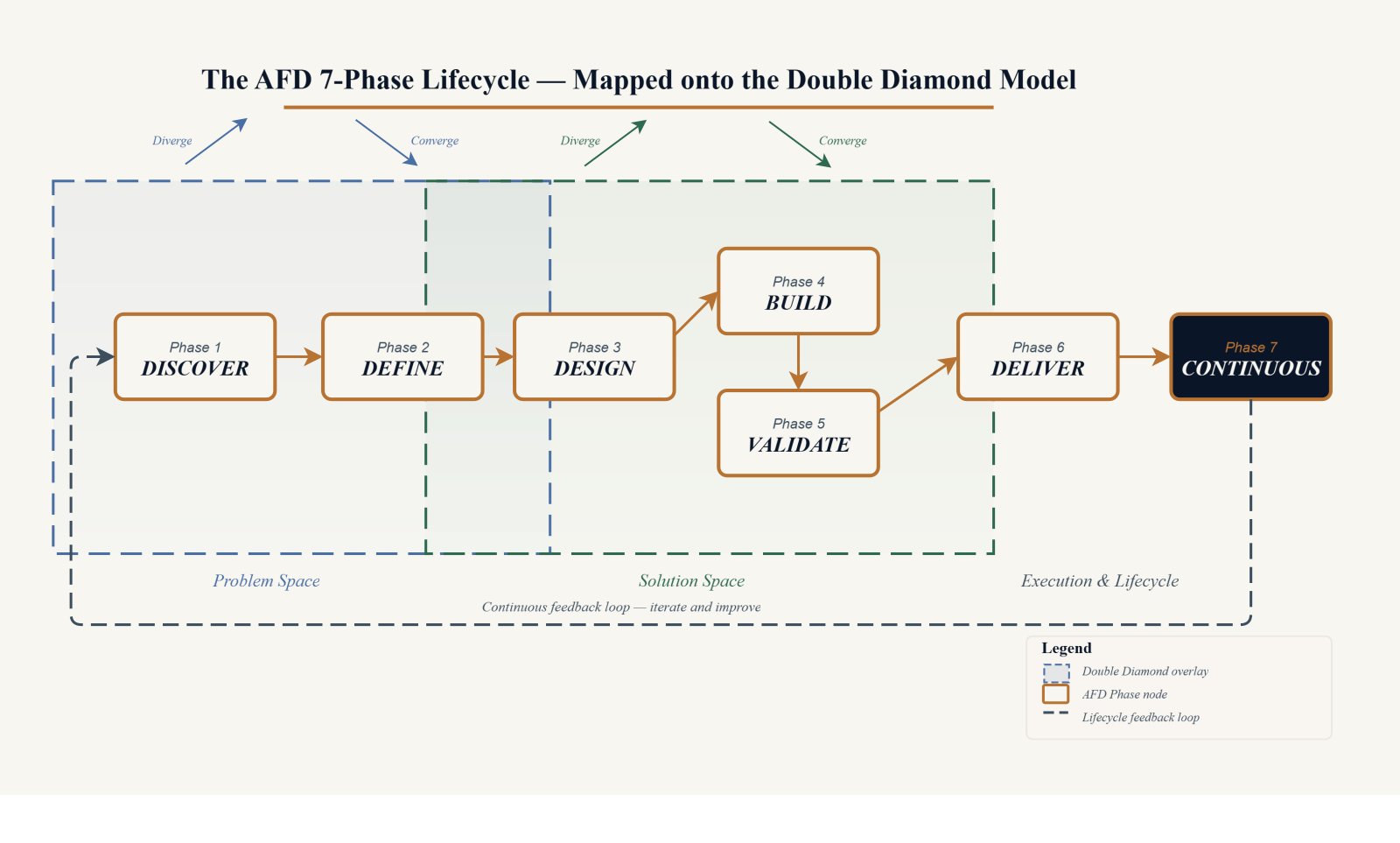
Adaptive Flow Delivery is built for exactly this moment. The core move is simple: take a little of the time AI just handed back and spend it on understanding what to build — the complete picture, not fragments — before a machine builds the wrong thing at full speed.
Do that, and the number that started this — rework at 25 to 40% of build — drops to under 10%. That is not a tidier process. It is the difference between a ten-times gain that compounds and one that evaporates.
The method gives that discipline a shape:
- Seven phases that carry work from a vague request to confirmed value, with the heavy thinking front-loaded where it is cheapest.
- Confidence Gates — explicit points where a named person commits, on recorded evidence, that the team understands the right problem and has a workable solution before the build proceeds. Gates instead of ceremony.
- The Analysis Dividend — the economic case that the cost of understanding something properly is almost always lower than the cost of building it wrong, and that the dividend grows, not shrinks, as AI accelerates creation.
- A chapter for every seat at the table — CEO, CIO, portfolio manager, project manager, architect, analyst, developer — because AI changes everyone's work, not just the builders'. Delivery only changes if the whole table changes together.
Built for the AI era, not retrofitted to it
This is not an older methodology with a chapter on AI bolted to the end. The premise of the book is the inversion itself: when building becomes trivial, understanding becomes the scarce, decisive capability — and the delivery model has to be rebuilt around that fact.
So the book treats AI as a first-class part of delivery. It covers how to govern AI-written code so speed does not quietly become risk, how to keep a defensible trail of who decided what and why, and how the roles on a team shift as more of the building is delegated to machines and more of the value moves to judgment. The teams that internalise this will ship AI-fast and right. The rest will simply produce wrong software faster than before.
You don't need all 586 pages to know if it's for you
It is a 586-page reference, but it is not meant to be read cover to cover in one sitting. Read the opening — it is free on the site. Then read the Part 2 chapter for the role you actually hold. Ninety minutes, and you will know what your work becomes when AI does the building, and where to start.
Get the book
Adaptive Flow Delivery: Analysis-First Delivery for the AI Era is available now on Amazon. Read the free opening and explore the method at afdinstitute.com.
The building was never the bottleneck. Understanding is — and it has never been more valuable than it is now.